
Reviewed by Beth Brown Preston
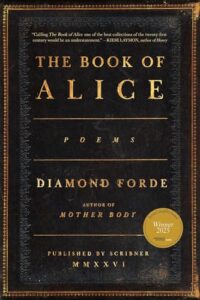
Diamond Forde
ISBN: 978-1668078402
Scribner, 2026
96 pages, $17 , Paper
Diamond Forde has released her second collection of poetry—The Book of Alice. This collection is a frank and honest look at faith, family, and the legacies we inherit from our elders. Forde recalls her grandmother, Alice, who always kept her King James Bible next to her bed on the nightstand. Alice was born and raised in the Jim Crow South. She survived a difficult childhood, married, and birthed eight offspring, one of whom was Diamond’s mother. When Alice died, Diamond inherited the family Bible from her grandmother and drew from the sacred ancient text the inspiration to write The Book of Alice. Alice lived in the pre-civil rights America of the South. Her personal mission was to save her children from harm. She did not believe in, nor trust, the safety of her world. Instead, she came to believe in the comfort and salvation of eternal life. And this faith uplifted her very soul.
The book is organized into five sections, each section named after a book of the Bible, with the exception of one apocryphal addition—the second section titled “Daughters.” The poet weaves imagery and linguistic improvisation with stylized form. The poet writes of the ways that we only can find evidence of African American life through archives meant to “categorize our death”—meaning stock lists, obituaries, and police reports. Forde resists those categorizations as an attempt to erase the humanity of African American people. She has said: “Part of what I’m trying to capture in the book is the successes and failures of my grandmother’s survival and, in particular, the way that that surviving still manifests in me as a thing that I am holding onto.”
Diamond discovers herself through a reimagining of her grandmother Alice’s story and Alice’s faith in the Bible. Four of the collection’s five sections are titled “Genesis,” “Exodus,” “Lamentations,” and “Revelations.” Set off in red ink, the poet includes words Alice herself wrote inside her Bible. In the poem titled “Creation Myth: Alice,” she features numbered verses, similar to a biblical text, and vividly describes an episode from Alice’s life as a young girl in the Carolina cotton fields:
3 Outside, Alice dodged the nipping stalks, her dress
fanning like the unbroken wings of a sandhill crane -Alice
dipped to unfix each boll with a twist, then unbent, her dark
hair lagooning till, fed up, she wrapped the flooding coils into
a basket around her arm.
(“Creation Myth: Alice,” p. 9)
In the sixth verse of this poem, Diamond quotes from one of Alice’s marginal notes recorded in her Bible: “The first man to ask me to marry him, I will.” Thus begins Alice’s journey, a journey that will take her from the cotton fields of North Carolina to New York in the Great Migration, and back south again to raise eight children.
Another poem titled “Womaning” is a text replicated verbatim from the margin of her grandmother’s Bible:
Love, God say, is obedience, so I obey
the alarm of sun sung through my window,
climb down cold steps ta hymn & hem, ta cook,
clatter, & kid myself into believing these tasks
don’t hook familiar shackles, & when my man
kiss me in the soft spot below my ear, I dream
he really want me, but that’s what’s wrong
with womanin’, we stay spinning yarn
from the colorful crochet of our minds, but few
admire it—Dear LORD, why did you make me
in your image if you wanted me ta kneel?
Let me break the rules one time, lace the loafers
by the front door on my large, girlish feet,
then walk like I got somewhere, everywhere, to go.
(“Womaning,” p. 41)
The Book of Alice has been called a love story and a coming-of-age story in which a Black girl matures and grows into womanhood while her grandmother recalls her own earlier life. It is an exploration of the poet’s lineage, and her legacy of survival, as seen through her grandmother’s eyes, using the King James Bible as a narrative framework. The poet draws a revealing parallel between biblical narrative and the storytelling in the life of a person relegated to the margins of society.
Published in Cider Press Review, Volume 28, Issue 2.
 Beth Brown Preston is a poet and novelist. A graduate of Bryn Mawr College and the MFA Writing Program of Goddard College, she has been a CBS Fellow in Writing at the University of Pennsylvania and a Bread Loaf Scholar in Nonfiction. She has published three collections of poetry with the Broadside Lotus Press and Aquarius Press/Willow Books, and two chapbooks of poetry. Her recent poetry collection, OXYGEN II (Aquarius Press/Willow Books, 2025), was nominated for the 2026 Paterson Poetry Prize.
 Diamond Forde’s debut collection, Mother Body, won the 2019 Saturnalia Books Poetry Prize. Her awards and prizes include the Pink Poetry Prize, the Furious Flower Poetry Prize, the College Language Association’s, and the Margaret Walker Memorial Prize. Forde has been a 2022 Ruth Lilly and Dorothy Sargent Rosenberg Poetry Fellow, a Callaloo Fellow, and a Tin House Fellow. Her work has appeared in the Massachusetts Review, Ninth Letter, NELLE, and Tupelo Quarterly. She has served as the fiction editor for Nat. Brut and interviews editor for Honey Literary. Forde earned a B.A. in English from the University of West Georgia, an MFA from the University of Alabama, and a PhD in African American Poetics from Florida State University. She is an Assistant Professor at North Carolina State University.
See all items about Beth Brown Preston
Visit Beth Brown Preston’s contributors page.
See all items about Diamond Forde
Visit Diamond Forde’s contributors page.