
Reviewed by Caron Andregg
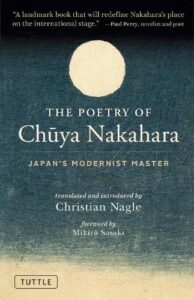
Modernist Master
Chūya Nakahara, translated by Christian Nagle
Tuttle Publishing, 03/10/2026
ISBN:9784805318973
384 pgs / $24.99 / Hardcover
As I am finishing up writing this review of The Poetry of Chūya Nakahara: Japan’s Modernist Master, (Tuttle, 2026), the massive Comic-Con convention is wrapping up in my city, San Diego. Comic-Con is a celebration of Pop Culture media, especially comic books, manga, video games, fantasy and sci-fi movies, and of course, anime. The name Chūya Nakahara would be familiar to many Comic-Con fans as the charismatic, hyper-violent, supernaturally-gifted, gravity-wielding Yokohama gangster in the 2016 anime series Bungo Stray Dogs. “Bungo” means “literature” in Japanese, so the proper title in English might be “Literary Stray Dogs.” All of the Japanese characters in the anime are named after significant writers of the Japanese Modernist movement.
That’s a fun fact, but let’s get back to the real author and this stellar new collection, translated and introduced by Christian Nagle. English-speaking audiences have not previously had much access to Japanese Modernist poets. Prose writers, yes (especially after the Nobel Prize was awarded to novelist Yasunari Kawabata); poets, no. The Poetry of Chūya Nakahara: Japan’s Modernist Master, a towering new compendium of Nakahara’s collected work, goes a long way toward rectifying that deficit. The 367-page tome feels like a labor of love from translator Christian Nagel, who began work on Chūya’s poems in 1999. Nagel’s translations are thoughtful, careful, and accessible, while remaining faithful to the original texts.
The Japanese Modernist movement emerged in the early 1900’s as Japan was undergoing massive cultural upheaval and an explosive transition from rural to urban culture. The Modernists rebelled against traditional classical forms and began experimenting with western-style free verse, fractured, stream-of-consciousness narrative, and the colloquial diction of spoken Japanese.
Chūya (“like Danté, he is affectionately called by his first name” (14)), emerged toward the beginning of this aesthetic shift. Over the course of his very short life, he compiled only two full-length manuscripts, neither of which sold well when they appeared in the 1930’s. It wasn’t until after WWII that a reeling post-war Japan was finally ready to embrace Chūya’s themes of urban isolation and existential angst.
Chūya had mastered classical Japanese poetry forms from an early age and had several works published as a young teenager. Then, he discovered and fell in love with the French Symbolist writers, especially Rimbaud. You can see both influences repeatedly in these collected works.
Chūya frequently uses classically naturalist titles throughout his works: “Spring Night,” “One Summer Day,” “Blind Autumn,” “Snowy Evening,” “Winter Dawn,”…. They go on and on. However, those classical titles serve as foils for the reader, setting up the expectation of a conventional structure, only for that expectation to be dashed on the cutting-edge, form-breaking verse. The title “Winter Night” (238) invariably portends a classical contemplation of beauty and stillness . . . , or, not:
“Everyone is quiet tonight
you can hear the kettle
I’m thinking of a woman.
although I have no woman.
[. . .] thus, the night deepens
on a winter night when only my dog is awake
shadows and cigarette and me and the dog
that is an incredible cocktail.”
In “Spring and Baby” (254), the echo of a sleeping baby’s cry from the field turns out to be only urban noise:
“in a field of rapeflower blown about by the wind . . .
is that a baby?
No, creaking in the sky are lines—the power lines.
All day those power lines creak in the sky.
But crying in the field of rapeflower—that is a baby.
What runs past is bike, bike, bike
running along the far side path
with the pale pink wind at its back . . .”
The influence of Rimbaud and the French Symbolists is ever-present throughout the collection. In “Hangover” (94), the narrator wakes to find “Morning, the dull sun shining / and it’s windy. // A thousand angels / play basketball.” In “Untitled” section III (134) a dream of personal connection dissolves—elegantly— into drunkenness and isolation:
“In such a world of sad living, let not
your heart harden.
I want mine to draw close to you,
so let not your heart harden.
For when yours hardens, its eyes—
the soul’s labor of words—are lost.
When calm, all men can share innate
beautiful dreams, and also their reasons.
I forget and abandon my heart, my soul,
seek beauty in a drunken, mad feeling.
How sad my world is.”
Chūya’s work is infused with the Modernists’ fascination with the noise, crowds, and increasing isolation of Japan’s burgeoning urban landscape. However, Chūya juxtaposes that isolation and alienation with images of profound beauty and personal longing. In “Lost Hope” (116):
“I have no way of knowing
when this misery will end.
It’s like seeing the moon
from an ocean where I’m drowning.
The waters are so deep
the moon so clear—”
In “Blind Autumn” (100):
“My youth is already a hardened artery
through which flow red spider lilies and evening sun.
Quiet, gorgeous, and brimming,
like the last smile of a leaving woman,
solemn, rich, desolate,
unusual, warm, glittery, it touches my heart . . .
Ah, how it touches my heart . . .”
This new collection brings together poems from both of the manuscripts that were prepared for publication during his short life, the self-published Goat Songs and the posthumously-published Songs of Bygone Days. In addition to the poem translations themselves, this definitive bilingual edition also includes substantial biographical information, photo plates, and a link to audio recordings of the poems in both Japanese and English. With the publication of The Poetry of Chūya Nakahara: Japan’s Modernist Master, Chūya’s remarkable body of work is now easily accessible to American readers.
And, back to Bungo Stray Dogs for a moment; if a bizarre, violent, crime ridden, niche anime can help promote interest in Japanese Modernist writers in the US—especially the formerly-underrepresented poets—then I am here for it. This is a volume that will live rent-free on my bedside table for years to come.
Published in Cider Press Review, Volume 28, Issue 4.
 Caron Andregg is the Publisher and Editor-in-Chief of Cider Press Review. She holds an MS in Television/Radio/Film from The Newhouse School (Syracuse University) and an MFA in Creative Writing from San Diego State University. She has taught screenwriting, literature, composition, and rhetoric at institutions including Penn State and San Diego State. Her poems have appeared in print and online journals including Spillway, Rattle, Poetry International, Solo and many others, and in the anthology Line Drives: 100 Contemporary Baseball Poems (2002) published by Southern Illinois University Press. In her non-poetic life, she works as a publisher, book designer, compositor, and consultant, with too much help from office cats.
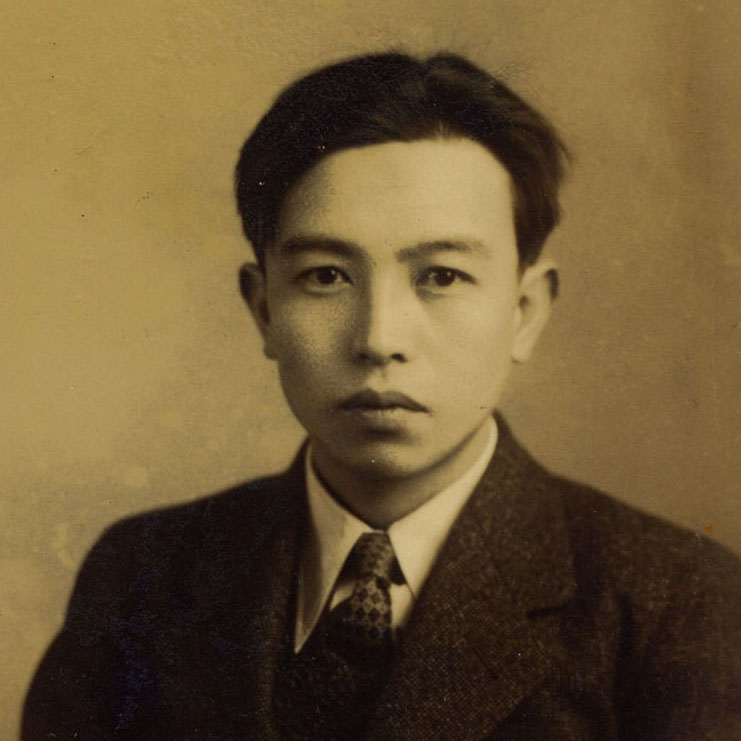
 Chūya Nakahara (中原 中也, Nakahara Chūya; 1907–1937), born Chūya Kashimura (柏村 中也, Kashimura Chūya), was a Japanese poet active during the early Shōwa period. One of the young writers of the Japanese Modernist movement, he was one of the leading renovators of Japanese poetry. Heavily influenced by Dada and other forms of European (mainly French) experimental poetry, many called him the “Japanese Rimbaud” for his affinities with the French poet whose poems he translated in 1934. Although he died at the young age of 30, he wrote more than 350 poems throughout his life. From Wikipedia, the free encyclopedia, https://en.wikipedia.org/wiki/Chūya_Nakahara)
See all items about Caron Andregg
Visit Caron Andregg’s contributors page.
See all items about Chūya Nakahara
Visit Chūya Nakahara’s contributors page.