
Reviewed by Erica Goss
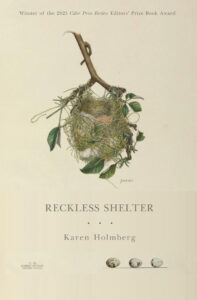
Karen Holmberg
ISBN: 9781930781696
LCCN: 2025951224
Cider Press Review,
(August, 2026)
80 pages, $20.95, Paper
Winner of the 2025
Cider Press Review
Editor’s Prize Book Award
“Can I break / my heart from clapping shut in this wonder / and wounder of a world.” These lines from “Manatee” represent the irony at the heart of Reckless Shelter, Karen Holmberg’s new poetry collection. In poems both courageous and tender, which read like dispatches from a wise, erudite friend, Holmberg evokes beauty and tragedy in equal measures. The devastation of loss opens new veins of comprehension, building connections between humans and nature.
The specter of impermanence gives these poems a sepia tint. With loss and grief on the horizon, signs emerge from the natural world. In “Late Walk,” for example, a woman walks near a train track with her mother and daughters. Time slows; nothing much happens until a train “wails by, its wake / of hot winds whirling.” The train’s unwelcome intrusion foreshadows the grandmother’s coming death. Senses acute to the smallest details, the speaker notices the connection between the “light / like mother of pearl” and her mother’s “long hair, which / up close / is not simple, but alight / with strands of platinum / and palest gold.” That which is most precious, the poem tells us, vanishes even as we try to keep it near us.
As Holmberg shows us in “Daily, We Home-Wreck,” the smallest acts have consequences. Disturbing the nest of a spittlebug, which Holmberg describes as “a smear of foam— / lace curtain in which / a pale green wizard squirms,” the speaker realizes that by simply moving her arm, she has inadvertently destroyed its home. The rumination that follows, which she recognizes as “palace-building,” uses wordplay to effect: “its only limb is a flake / of fluke” and “Each sphere of spit assumes / the world in fragile, / fractal brevity.” These thought-bubbles, “a surfeit / from my brain,” build a new structure:
From my mouth,
word upon word, I assemble
this reckless shelter.
The last line contextualizes the book’s title, Reckless Shelter: a life is no more or less than a structure of words, even a life as brief as an insect’s.
Holmberg revisits time’s elasticity in “Confession.” After witnessing the death of a loved one, the speaker recalls how the dying person’s last breaths shocked her: “you drew a last breath / deep in your belly. // I gasped in surprise.” Death watchers, trapped in what Emily Dickinson called the “Hour of Lead,” inevitably experience a sense of release when death arrives. The speaker’s gasp is not the result of surprise or disbelief, but instead wonder, a “visceral astonishment:”
It was breaking
the surface without you. It was letting
my held breath go to draw
the sweet air in.
That final breath releases the speaker, her relief palpable. The confession comes later: the speaker, struck with death’s finality, wonders if the dying person heard that gasp “as scorn / or bitter scoffing?” She will never know, and we will never know; when she admits, “Forgive me the truth: / I was rushing you on,” we empathize with her—who has not regretted a careless remark, wishing to explain and apologize long after it was too late for either?
After death, a loved one’s possessions take on an outsized, even uncanny significance. Drawers reveal strange objects, tucked away for years. Their mother’s death freeing them to search out those odds and ends, a trio of sisters finds three dolls, “dormant // in crocheted shrouds” (“Everything Is an Instrument and Gives Its Own Song”). These “alternate daughters,” kept by their mother, imply an interconnected network of mothers and daughters, recalling a woman who “fostered infants taken / by the state,” whom she cares for “far beyond the borderlands / of love.” The sisters, linked “by the stronghold of my mother’s heart,” accept the dolls, with their cracked plaster faces and wigs of human hair, as if they were adopted babies, or perhaps gifts their mother hid for them to find after her death.
“A garden is a power / of memory, able to outlast / its maker,” Holmberg writes in “Weeding My Mother’s Garden.” Balanced between the beauty of the natural world and the ever-present threat of loss, these poems show us how we are all connected. Treat this world with care and respect, the poet tells us. It’s the only one we have.
Published in Cider Press Review, Volume 27, Issue 2.
 Erica Goss is the winner of the 2019 Zocalo Poetry Prize. Her collection, Night Court, won the 2017 Lyrebird Award from Glass Lyre Press. Recent and upcoming publications include Creative Nonfiction, North Dakota Quarterly, Spillway, A-Minor, Redactions, Consequence, Slant, The Sunlight Press, The Pedestal, San Pedro River Review, and Critical Read. She is the founder of Girls’ Voices Matter, a filmmaking workshop for teen girls. Erica served as Poet Laureate of Los Gatos, CA, from 2013-2016. Erica is the editor of the newsletter Sticks & Stones.
 Karen Holmberg won the 2025 Cider Press Review Editors’ with Reckless Shelter. Reckless Shelter is scheduled to be published in August, 2026. Holmberg’s two poetry volumes are The Perseids (winner of the Vassar Miller Prize/University of North Texas Press) and Axis Mundi (winner of the John Ciardi Prize/BkMk Press). In addition to poetry, she publishes lyric essays and art criticism, appearing in At Length, Tupelo Quarterly, and the Notting Hill Editions Prize anthology. Recent poems have appeared in Southern Poetry Review, and were featured in the spring issue of High Country News. Her first young adult novel, The Collagist, won the 2021 Acheven Prize and was published by Regal Press/Fitzroy Editions in the spring of 2024. She teaches British Literature, poetry writing, and letterpress printing at Oregon State University, where she is on the MFA in Creative Writing faculty.
See all items about Karen Holmberg
Visit Karen Holmberg’s contributors page.
See all items about Erica Goss
Visit Erica Goss’s contributors page.