View From a Borrowed Field
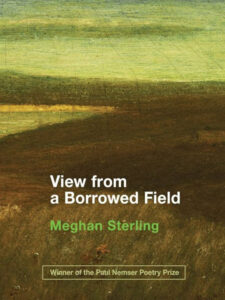
ISBN: 978-1957755199
2023, Lily Poetry Review
$18, 80 pages, Paper
Reviewed by Abbie Kiefer
Meghan Sterling’s View from a Borrowed Field offers its central tenet in “Stone Fields with First Snow,” the collection’s preface poem: “Where the back is broken, love can grow. Where the land / is broken, the cold comes and makes of it a coat.”
This poem, with the sensibility of a parable, establishes the speaker’s perspective on the world. One must notice and grieve for brokenness but need not let brokenness define a place or a life. As the speaker gives name to her own aches and is witness to the aching of others, she also serves as a conduit for beauty. This book, then—necessarily and compellingly—is built on tension. We see how the speaker’s dream space seems often at odds with her waking life, how slamming her own hands against her head “quiets the noise, / soothing like a ragged purr.”
In “Before School There Are Icicles,” which describes gorgeously how a winter landscape can delight, the daughter asks her mother for one of the frozen spikes—“each tender icicle like a finger prick of good for her to taste—” and we understand that this goodness is accompanied by risk: the finger prick, the ice-slick ground, the cold that threatens bare skin. The ice is still praiseworthy, but its danger must be recognized.
This collection begins with orderly progression: poems set in winter followed by poems set in spring. Then the pandemic-focused poems begin to appear. They feel jarring to the reader in the same way that the spread of COVID-19 stunned us with its speed and severity. These poems have fewer references to seasonality, and so the reader—like the speaker, sheltering in place—has fewer ways to mark the passage of time. Instead, there’s a sense of confinement.
Sterling uses these pandemic-shaded poems, in part, to explore family and what we can rightfully expect of it. In “The First Days,” the speaker describes her empty neighborhood, everyone hiding “from each other, as if in our homes / we can find the only solace in strange times, / in the faces of those we love, in the wanting that never ends.”
Is solace always so available? Can—or should—wanting be conquered? This collection doesn’t presume to answer these questions, but it does open us to their asking as the speaker explores parenting and mental health and the work it takes to create a life with a partner.
And then—as we consider all of this, as we are still a bit adrift—seasonality returns in the collection’s penultimate poem, “Field Notes.”
The snap peas will be ready to pick in June, the wood stove done
for the year by then, and my daughter will find a conch shell in
an old shed, blowing into it as if it is the shofar, calling us to come,
to clear, to make this land our own.
The title “Field Notes” reminds us of the collection’s eponymous borrowed field, which, because of its borrowedness, is a place of impermanence—the speaker’s claim to it limited by her mortality. There is inherent sorrow in recognizing our own finitude and yet it’s a relief to return, in this stanza, to marking the passing days because the speaker can plan how to use them: harvesting her garden, listening to her daughter, binding her family and herself to land they love.
This is, in my mind, the same plot the speaker walks in “Stone Fields with First Snow”: “We could live here, I thought. This broken earth. / This land of hard hard rock. We could plant and make things soft // or come to ruin—right here.” The speaker understands her limited agency. She could come to ruin. She will steward the land for a finite time. But neither the possibility of the first nor the inevitably of the second discourages her from working to soften the land. To plant all the good things she’s able.
It’s that tension, that aching. And like the speaker, we are its witness, all of us better for it.
—
View From a Borrowed Field (Lily Poetry Review, 2023) was the winner of the Paul Nemser Book Prize.
Published in Cider Press Review, Volume 26, Issue 6.
 Abbie Kiefer is the author of Certain Shelter (June Road Press, 2024) and the chapbook Brief Histories (Whittle Micro-Press, 2024). Her poetry has appeared or is forthcoming in Boulevard, The Cincinnati Review, Copper Nickel, The Missouri Review, Ploughshares, The Southern Review, and other places. She is on the staff of The Adroit Journal and lives in New Hampshire.
 Meghan Sterling lives in Portland, Maine with her family. She is co-editor of the anthology, A Dangerous New World: Maine Voices on the Climate Crisis, published by Littoral Books. Her work has been published in Rattle, Balancing Act 2, Glass: A Journal of Poetry, Driftwood Press, Sky Island Journal, Literary Mama and forthcoming in Maine Poet’s Protest. Her chapbook, How We Drift, was published by Blue Lyra Press. She is a poetry reader for the Maine Review, Featured Poet in Frost Meadow Review’s Spring 2020 issue, and a Hewnoaks Artists’ Colony Resident in 2019. Her work can be found at meghansterling.com.
See all items about Abbie Kiefer
Visit Abbie Kiefer’s contributors page.
See all items about Meghan Sterling
Visit Meghan Sterling’s contributors page.