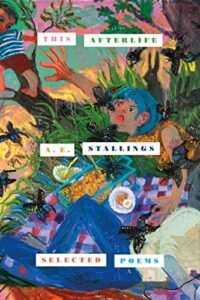
ISBN: 9780374600693
(Farrar, Straus and Giroux, December 2022)
240 pages, $28.00, Hardcover
Reviewed by Susan Azar Porterfield
Rhyme makes things true: If the glove don’t fit, you must acquit. Somewhere in our brains, in our vibrating quarks, hearing or reading rhyme signals that the world makes sense after all. Structure, reason, meaning, all exist because two sounds, linking, click shut like a snap purse clutch. Thus, we can rest easy, or easier, for a time, and that moment feels incredibly good. There is pleasure in rhyme, almost physical pleasure. As when we eat grapes, a bunch of rhymes, bursting one after another in our brains and on our tongues is luxurious, little jolts of juice.
In a time when rhyming verse is not as expected as it once was, A.E. Stallings is known for her rhymed and metered poetry as well as for her translations from the Greek.
She’s the author of Like (2018), which was a Pulitzer Prize finalist, Olives (2013), finalist for the National Book Critics Circle Award, Hapax (2006), a winner of the American Academy of Arts and Letters’s Benjamin H. Danks Award, and Archaic Smile (1999), winner of the Richard Wilbur Award. She has translated Lucretius’s The Nature of Things and Hesiod’s Works and Days, as well as ‘The Battle Between the Frogs and the Mice’: A Tiny Homeric Epic. Stallings is a 2011 Guggenheim Fellow and a 2011 MacArthur Fellow.
This latest collection of her work draws upon selections from her four previous books of poetry. As a classical scholar, trained at Oxford, Stallings’s earlier work, Archaic Smile (1999) in particular, frequently refers to and retells Greek myth, as in this piece, “Daphne”:
Poet, Singer, Necromancer— I cease
to run. I halt you here, Pursuer, with
an answer:
Do what you will.
What blood you’ve set to music I
Can change to chlorophyll,
However, Stallings really can’t be pinned down. She also writes about moving to Greece as a newlywed, about her children, about the tension, for women, between being both an artist and a mother, as in “Study in White” in which a friend, a visual artist, seemingly must choose between using lead in her mixture for the color white—lead that can seep into her body—or the health of any future children she might have.
That you may use titanium or zinc,
Not poisonous, but you may be reviled
Because you lack the seriousness bred
For art in men—or how else could you think
Of compromise in this. And I own
I’ve tried them both, but the best white is lead
In whatever form we tell them, perhaps via ancient myth or fairytale or legend, the stories that survive are those that show us something piercing about what being human means. Think Demeter. Think Achilles or Oedipus. Hansel and Gretel. What is long ago and far away, these narratives reveal, is also now, is here. Stallings’s books often make that time-connection clear, as in the poem “First Love: A Quiz” from Hapax (2006).
He came up to me:
a. in his souped-up Camaro
b. to talk to my skinny best friend
c. and bumped my glass of wine so I wore the ferrous stain on my
sleeve
d. from the ground, in a lead chariot drawn by a team of stallions
black as crude oil and breathing sulfur; at his heart, he
sported a tiny golden arrow
Apparently, bad-boy attraction is bad-boy attraction, regardless of century. In other words, in this poem, Stallings hooks us up with something true and eternal. We can feel it. Although the details may vary or the circumstances change (take your pick—a.b.c.d.) the essential element, the core, is untouched. This quality seems to me to be what best defines poetry as well.
Published in Cider Press Review, Volume 24, Issue 5.
 Susan Azar Porterfield’s three books of poetry include In the Garden of Our Spines, Kibbe (Mayapple Press) and Dirt, Root, Silk, which won the Cider Press Review Editor’s Prize. Individual poems have appeared in The Georgia Review, Barrow Street, EcoTheo, Mid-American Review, North American Review, Crab Orchard Review, Nimrod, Rhino, Puerto del Sol, Poetry Ireland Review, Slipstream, Room, Ambit, Magma. Porterfield is a Poetry Editor at Cider Press Review.
 A.E. (Alicia) Stallings grew up in Decatur, Georgia. She studied classics at the University of Georgia and Oxford University. Her poetry collections include Like (2018), which was a finalist for the Pulitzer Prize; Olives (2012), which was nominated for a National Book Critics Circle Award; Hapax (2006); and Archaic Smile (1999), winner of the Richard Wilbur Award and finalist for both the Yale Younger Poets Series and the Walt Whitman Award. Her poems have appeared in The Best American Poetry anthologies of 1994, 2000, 2015, 2016, and 2017, and she is a frequent contributor to Poetry and the Times Literary Supplement. Stallings’s poetry is known for its ingenuity, wit, and dexterous use of classical allusion and forms to illuminate contemporary life. In interviews, Stallings has spoken about the influence of classical authors on her own work: “The ancients taught me how to sound modern,” she told Forbes magazine. “They showed me that technique was not the enemy of urgency, but the instrument.”
See all items about Susan Azar Porterfield
Visit Susan Azar Porterfield’s contributors page.
See all items about A.E. Stallings
Visit A.E. Stallings’s contributors page.