
Reviewed by Elizabeth Hoover
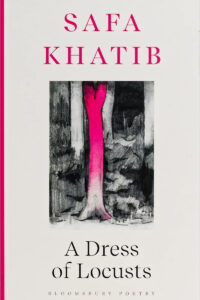
Safa Khatib
ISBN: 9781526667960
London: Bloomsbury, 2025
64 pages, $18, Paper
Safa Khatib’s debut collection, A Dress of Locusts, moves through vast swaths of geography, culture, and eras while also being a compact and tightly organized collection. In this trans, transnational travelogue, the narrator moves through ruins littering the present landscape and excavates ancient structures of thought that continue to shape our understanding of power, all while reverently marking the limits of what can be know.
One of the central concerns of the book is preserving what is unknown and unknowable. It begins with the short lyric poem, “Life in My Country,” which centers on the image of the speaker kissing a dark rock. Then “someone else” appears and chants, “Sister. Sibling. Stranger. Splendor.” Here the intimate and the strange metamorphosize into a splendor that breaks the logic of the sentence, shattering meaning into sound. In this way, the poem asserts that intimacy doesn’t require knowing the other. Instead, it requires a willingness to engage deeply with their strangeness without attempting to overtake with understanding. In short, these poems use reverence, not explication, to usher in the splendor and refuse colonial logics.
With stark enjambment, generous use of caesurae, and deployment page space, Khatib’s structure forces the reader to linger in these intimate and mysterious places, to feel the productive discomfort in not quite belonging to a space while also recognizing things about it. Her poems’ pace mimics the process of thinking through something difficult, but essential. For example, the poem “Thresholds” begins in a room of statues that the poet walks through “curious about the lives/ of those idol makers….each all-but-eroded face/ could tell you nothing” (13). Even though the faces yield no new insight, the poem spools out for another thirteen pages as it explores the threshold between curiosity and realization.
The poems all linger at this threshold and are punctuated by images of boundaries being transgressed like a glowing vending machine the speaker yearns to climb into, the chimeric creatures her lover draws in private, or calling herself a vacant room with “various guests” wandering in and out (6).
Conceptually, each poem holds the reader in an in-between space as Khatib yokes together seemingly disparate elements: sex toys and Quranic verses, the Iliad and untranslated fragments of Spanish, idols and Christianity. In a more literal sense, subjects seek out their pain thresholds in poems describing BDSM scenes. She asks, “What will we risk? I’ll go as far as you’ll take me.” Even while experiencing erotic “overwhelm,” she is needled by either the insufficiency of her knowledge or the stubborn will of the world to retain its strangeness. She writes, “Again the pain of what I cannot know/ of you penetrates me” (3). In the BDSM scene, pain is closely related to pleasure, which opens the possibility that the inability to unlock those withholding faces of statues and fully know the past a type of erotic pleasure.
In a poem about making love to an imam, she writers, “Sex was where the distinctions/ I’d for so long been taught—between reason/ and ecstasy, duty and joy—might, as I reached/ back for him, lose their power” (27). The distinction between the gesture of prayer and the gesture of fucking dissolves, then the speaker walks home to care for her ailing neighbor. These two acts, with their spiritual overtones, exist comfortably within one poetic space. She asserts, “’I’ was the need for relation” (12) and that need is fulfilled by the poet being in relation to a text, a cracked statue, or kneeling in front of a stranger to massage the pain from their legs.
Finally, the threshold is an oppositional space, a place that welcomes those “in love/ with quarrelling/ with what you learned” (14). This book engages in many quarrels—with empire, with changing desire, with faith. These quarrels take on a utopic edge when the speaker asserts “to remake the word/ you must first invent its past.” The act of invention collapses the past and present. What is thought to be ancient history can erupt at any time in gestures such as Ishtar handing the speaker the eponymous dress of locusts or Gilgamesh whispering secrets in a U.S. general’s ear in contemporary Bagdad.
In one of three poems called “Dear Safa” that appear throughout the book, the speaker spies the Lady of Warka, a sculpture dating from 3100 B.C. and thought to be the first anatomically correct representation of the human face, in a contemporary construction site:
The violence you know
is not the act of a stranger—
It is your sustenance: this continent
which remains
The American night, the ancestral crime—
See that your face
is so like her alabaster face:
a record of a past, altered beyond recognition. (42).
The syntax allows us to read both faces as “altered beyond recognition,” and therefore the similarity the speaker seeks in the mask is that mutual unintelligibility. But the speaker also sees a record of her own complicity in empire-building. Though the book opens with the act of creating a country where kissing stones ushers in splendor that opens the book, the poet eventually concedes that she cannot created her own country because the crimes of her native follow and make her. She writes, “the conditions of perpetual war/ will comfort you/ they shape/ what you may think/ and when.” The ability to transgress borders and boundaries is not just a search for knowledge, but a privilege of the American traveler for whom “the news/ is always the news of your innocence” (8). In another “Dear Safa” poem, Khatib writes, “You are one of the good ones/ you have learned well/ that the destruction of life/ is a requirement/ of national security” and repeats “you are one of the good ones,” a fragile mantra for trans of color travelers (9).
In the face of the catastrophic ruin of millennia’s worth of violence and war and the present’s stubborn refusal to learn from it, it’s tempting to throw up our hands. But Khatib urges: “you too must make/ the arc of your life” (17). This is a book for those willing to take on that task despite the fact, or especially because, it requires finding splendor in the strange. It is a book dedicated to those “who love to endure/ thought’s chaotic journey—” and find a sense of belonging in the quarrel with everything they know.
Published in Cider Press Review, Volume 28, Issue 4.
 Elizabeth Hoover is the author of the archive is all in present tense, winner of the 2021 Barrow Street Book Prize. She received the Pat Holt Prize for Critical Art Writing from Lambda Literary and has published creative nonfiction in the North American Review, the Southeast Review, and StoryQuarterly. She is an assistant professor of English at Webster University in Saint Louis.
 Safa Khatib is a poet, translator, teacher and daughter of South Indian immigrants. Her writing has appeared in numerous journals, including Words Without Borders, the Baffler, the Kenyon Review and the White Review. She is the recipient of support from the US Fulbright Program and the Stadler Center for Poetry, among other institutions. She is currently a PhD student in the Track for International Writers in the department of Comparative Literature at Washington University in St Louis, Missouri.
See all items about Elizabeth Hoover
Visit Elizabeth Hoover’s contributors page.
See all items about Safa Khatib
Visit Safa Khatib’s contributors page.