

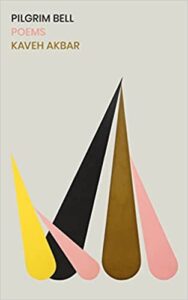
Kaveh Akbar
2021 Graywolf Press, 2021
$16.00 80 pp. Paper
(sponsored link)
Reviewed by Nikki Ummel
Kaveh Akbar’s second collection of poetry, published by Graywolf Press, debuted in August of 2021. A modest 76 pages, Pilgrim Bell takes a daring stab at some familiar territory for poets: what is language? What is lost- and gained- by language? How does language confine, define, and refine us? This book explores trials and tribulations, of many kinds—the self, faith, doubt, addiction, recovery, family, identity—but the overarching trial that binds all is that of language. Akbar roots the reader in his complex reality as an Iranian-born poet living in the United States, and through that rooting, language becomes both weapon and salve.
Take, for example, the fifth poem in this collection. In “Reza’s Restaurant, Chicago, 1997,” the speaker is out to eat with his family. His father identifies and labels various people in the restaurant: “Persian,” “Arab,” or “white.” The speaker, a mere eight years old and “soft as a thumb,” asks “how he could possibly tell.” “It’s easy,” his father replies, “we’re just uglier.” It is through naming, through the activation of language, that identity is formed. For Akbar, the self is inseparable from language.
Later in the book, “My Empire” also displays the power of language. In this poem, language and weapon become one and the same, both resulting in “a pile of rubble,” that “the prophets” are drawn to “as if to an amusement park.” The ultimate question raised in this poem is age-old: what is the cost of knowledge? To Akbar, love is “a kind of birth, an introduction to pain,” which leads to anger, and from anger, destruction. And the prophets? “A waste.” There is no relief in the deliverers of the word. Yet humanity has no other choice but to plow forward; it is our divine destiny. In “The Miracle,” Gabriel seizes “the illiterate man, alone and fasting in a cave.” Gabriel chokes the man, “squeezing him so tight he couldn’t breathe,” commanding that he “READ IN THE NAME OF YOUR LORD WHO CREATED YOU FROM A CLOT,” demanding literacy, a “Revelation.” In Pilgrim Bell, language is inseparable from knowledge, knowledge inseparable from pain, and pain inseparable from the Divine, who demands language. And the cycle continues.
Language, in its most simple form, is sound, and sound is produced by vibration (“all of language began / with a single / sound”). Akbar explores the weight of vibration through the six eponymous “Pilgrim Bell” poems scattered throughout the collection, creating a sense of tolling, a call to prayer, connection, and knowledge. “The difference between. / A real voice and the other kind. / The way its air vibrates. / Through you. The way air. / Vibrates. The violence. / In your middle ear.” Language is vibration, language is accumulation, and language is violence. In “There are 7,000 Living Languages,” Akbar writes, “When a boy starts speaking / his trouble begins.” And then later, “There is something terrible / beneath all I am able to say.” After all, “The Value of Fear” is “in its sound.”
Language confounds and disappoints, yet Akbar asks, is the poet the disappointed or the disappointer? What does it mean to be both? In “My Father’s Accent,” the speaker chastises, “Idiot poem, idiot hands for writing it.” For poetry to exist, to grow beyond the confines of the poet’s mind, the poet must engage in “Submission, resistance, surrender.” Writing, for Akbar, becomes a tête-à-tête. By the end of the poem, it’s the poet who admits fault, “my ignorance, is untranslatable,” causing the inverse to be true: knowledge is translatable because knowledge is language.
Pilgrim Bell aims to capture the complex relationship that exists between the poet and language, a relationship made richer by Akbar’s personal history with language: as an Iranian-American, as an immigrant, and as a Muslim. In Akbar’s collection, language is knowledge, but that knowledge is wrought with love, pain, and everything in between. Though there is no escaping it— it is what it means to be human. In the last poem, Akbar writes, “I, a man, / am what I do not say.” Some knowledge is too awful for language, “too wretched for letters,” and yet, the speaker finds the words, continues to express pain and suffering. For there is always “room in the language” for being without language. Even in the absence of language, language defines the speaker. So we might as well speak.
Published in Cider Press Review, Volume 24, Issue 4.
 Nikki Ummel is a queer writer, editor, and educator in New Orleans. Nikki has been published or has work forthcoming in Painted Bride Quarterly, The Adroit Journal, The Georgia Review, and others. She has been nominated for a Pushcart Prize, Best New Poets, Best of the Net, and twice awarded the Academy of American Poets’ Andrea Saunders Gereighty Poetry Award. She is the 2022 winner of the Leslie McGrath Poetry Prize. She has two chapbooks, Hush (Belle Point Press, 2022) and Bayou Sonata (NOLA DNA, 2022). You can find her on the web at www.nikkiummel.com
 Kaveh Akbar is the author of Pilgrim Bell (Graywolf Press, 2021), Calling a Wolf a Wolf (Alice James Books, September 2017), and the chapbook Portrait of the Alcoholic (Sibling Rivalry Press, January 2017). Akbar’s poems have appeared in The New Yorker, Poetry, Tin House, APR, PBS NewsHour, and elsewhere. He founded and edits Divedapper, where he interviews major voices in contemporary poetry. Akbar has received a Pushcart and a Lucille Medwick Memorial Award from the Poetry Society of America. In 2016, Akbar was a recipient of the Ruth Lilly and Dorothy Sargent Rosenberg Poetry Fellowship from the Poetry Foundation. He was born in Tehran, Iran, and is currently a professor in the MFA program at Purdue University and in the low-residency program at Randolph College.
See all items about Nikki Ummel
Visit Nikki Ummel’s contributors page.
See all items about Kaveh Akbar
Visit Kaveh Akbar’s contributors page.
