
By Caron Andregg, Publisher
It started with one short phone call.
In 1999, Robert Wynne and I were both in Los Angeles, fixtures in the vibrant and exuberantly productive LA poetry scene. At the time, Robert had recently edited the “Beyond the Valley of Contemporary Poets” anthology and I had been producing high-quality chapbooks and editing a poetry calendar and daybook.
During a phone call about…, something…, one of us suddenly asked the other: “Is it time we start our own poetry journal?”
 We were both on the same page and we had ambitions. Immediately we began soliciting submissions and work from authors—not just the many we knew in Los Angeles, but from throughout the US. It took almost a year, but by the beginning of 2000 we had Cider Press Review, Volume 1 in hand. To my mind it remains one of our best issues ever. We have published a new volume for every year since. This April, we launched the first issue of Volume 25.
Robert Wynne left the enterprise early in 2012 to pursue other projects. I have remained Publisher and (often) Editor-in-Chief with the help of a series of extraordinarily talented and generous editors, including Ruth Foley, Catherine Carter, Beth McDermott, and Catherine Campbell, not to mention the small army of assistant editors and readers.
A quarter-century milestone seems an apt time to reflect on what we’ve accomplished and where we’re going.
On a side-note, something about me personally that will illuminate this reflection. When I was very small, my mother started to suspect (with reason) that we had some Asian heritage mixed in with the more obvious Irish/European. In consequence, she made sure that I was exposed to Asian—especially Japanese—philosophies along with the usual European traditions.
Alas, the rise of easy genetic testing exploded my mother’s belief. That being said, I still benefited greatly by being nurtured with both Western and Eastern ideals. One of those ideals is Kaizen, or Positive Change.
In the Japanese language the word Kaizen is derived from two Kanji, the first ‘Kai’ 改, meaning ‘change,’ (or self-change), and the second ‘zen’ 善 , meaning ‘good.’ The term means, quite literally, ‘change for the better.’ The concept is widely applied in business practices around the globe, especially in manufacturing, where it is the basis for quality control and continual technical innovation.
However, I prefer to interpret Kaizen not as an external process but rather as an internalized state of being. For me, Kaizen represents a continual state of mindfulness, an appreciation of one’s current achievement coupled with the knowledge that there will always be room for improvement.
I believe wholeheartedly that every day I and CPR’s staff of dedicated volunteer editors and readers are continually refining our craft—just as the authors we showcase do. We approach Cider Press Review with a conscious and earned pride in how far we’ve come over the past quarter-century. Simultaneously, we never stop striving not only to find the best new poetry in the world, but also to discover better, more expansive and inclusive, and more beautiful ways to present that poetry. Kaizen as a state of being.
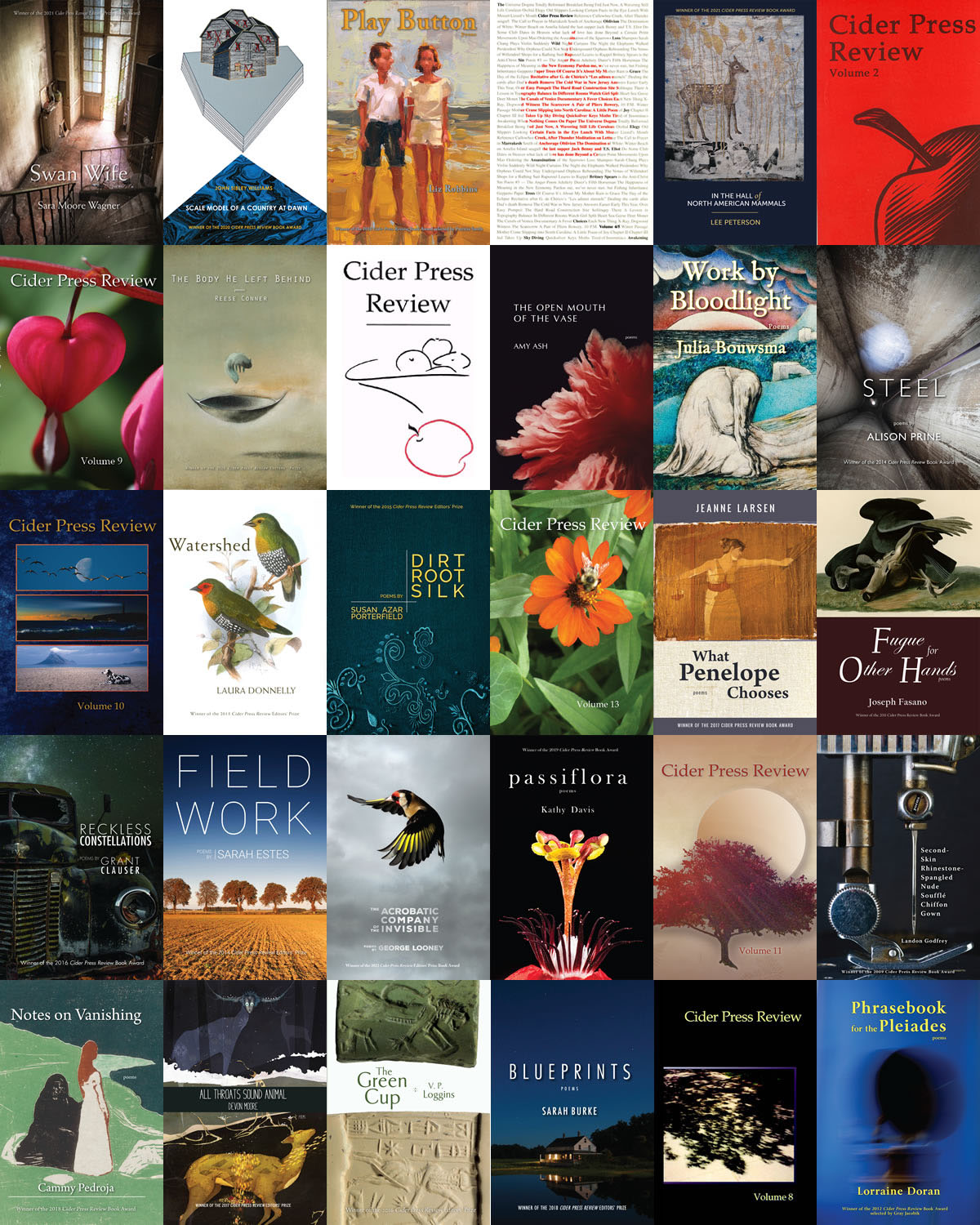
 As I look forward to the next 25 years, I’ve decided it’s high time to make a stronger statement about our underlying philosophy. Beginning with our most recent book, CPR publications have started wearing that philosophy on their sleeves. Or at least, their pages. When authors and subscribers receive their copy of George Looney’s moving The Acrobatic Company of the Invisible, they will see something new on the title page and the back cover: the watermark 改善 (Kaizen).
It has been my privilege to steward Cider Press Review for the last twenty-five years. It is my hope that it will continue with the same commitment to consistent excellence with change for the next quarter-century.