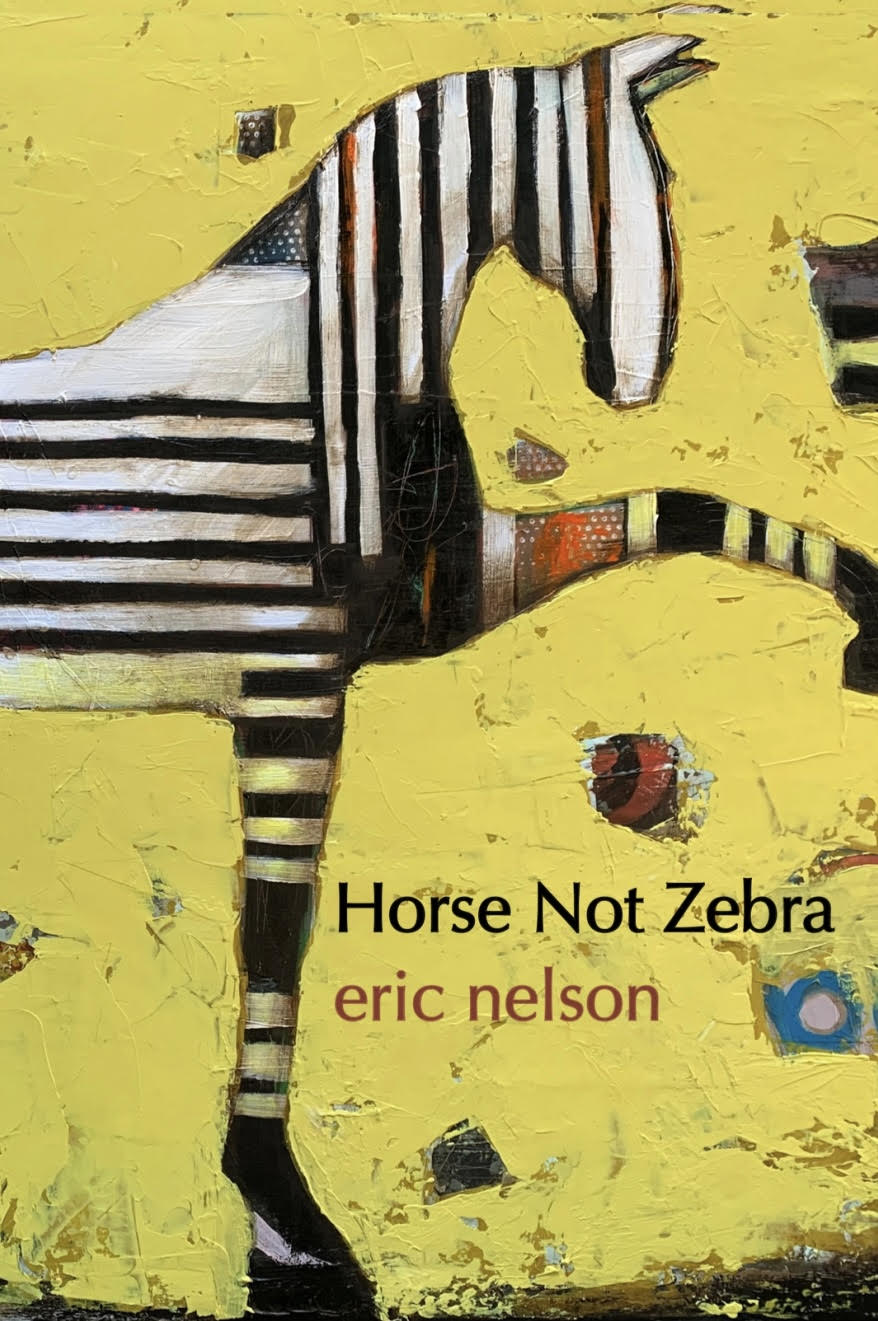


Eric Nelson
9781947896543
Terrapin Books (2022)
101 pages, $17, paper
(sponsored post)
Reviewed by Jayne E. Marek
Delightful, wry, and accessible, Eric Nelson’s seventh poetry collection is grounded in day-to-day living. Family dynamics, the vicissitudes of aging, and life in a Southern community provide Nelson with his topics. Nelson demonstrates a gentle humor and an ability to weave among subtleties and undercurrents derived from our fractious times.
Yes, the current state of the world may tempt people to catastrophize. In the title poem, Nelson recommends we respond to life events in measured, not extreme, ways:
when your phone rings at 3:00 in the morning,
think wrong number, not who died?
…think how,
when popping sounds wake you at night,
you think firecracker, not gun. (“Horse Not Zebra” 39).
By juxtaposing an initial overreaction with a calmer assessment, Nelson traces how knee-jerk defense mechanisms are part of human nature. And we may well feel the need for defensive postures: many pieces in this book reflect realistic stressors.
The pandemic, for instance, shows up in “Sheltered in Place,” as local wild animals seem puzzled why the humans stay inside so much. It’s an example of Nelson’s ironic touch that the animals ponder
why we’ve gone quiet. Why we appear as they do,
cautiously, before light, faces hidden. Hoping,
however they hope, we’ve changed. For their good.
The moon has come closer, too. It’s larger. Brighter.
The man in it gone.
The last hint that the pandemic might indeed mean the end of humanity—which probably would benefit the environment—is gently handled, but in full awareness of the sad state of the physical world.
The poem “My Alarm” lists “twenty-three species declared extinct…. record overdoses and evidence that summers burn / hotter and longer than ever,” as the speaker reflects on his neighbor’s perhaps-futile work as a landscaper. Nelson’s characters continue to mulch trees, plant in yards and gardens, and walk the dog, but with an eye open for what’s happening to the earth. In “When Water Is Up to Here With Us,” flooding swamps a home and “appliances… / float / through doorways / like sea mammals / migrating, following / food, singing to each other.”
Lighter moments balance the serious notes. “By Campfire” reflects on modern conveniences that baffle the speaker: if he survived an apocalypse, he reflects, he would be unable to help himself other than—maybe—make a fire to warm a few survivors. Such learned helplessness is given a modicum of grace: around the campfire, “I might recite / fragments of poems from the old world, smoke / like ghosts rising into the star-dotted night.”
Nelson is perpetually drawn to the hidden charms in life. “Bus Real” traces a couple’s nighttime bus trip through Madrid, as they observe riders, young and old, who emblematize the variety of the city neighborhoods. When these visitors reach the end of the bus route, near morning, they have appreciated an aspect of travel that few tourists experience:
The spotlit monuments led us to our hotel where we devoured
warm rolls and café con leche before we fell into our bed
and slept deep into the day, all the way through our tour
of the Basilica, which we’d heard is stunning, not to be missed.
The issue is deftly put: what do we value? What others tell us should matter, or what we personally find significant? Nelson shows us the pleasures that beguile him, so that we can honor our own.
Published in Cider Press Review, Volume 25, Issue 1.
 Jayne Marek’s poetry books include In and Out of Rough Water and The Tree Surgeon Dreams of Bowling, with a seventh collection, Dusk-Voiced, due in 2023. Her writings and photos appear in Rattle,Spillway,The New York Times,Bloodroot,Catamaran,One, Salamander,Gulf Stream,Calyx,Bellevue Literary Review, Women’s Studies Quarterly, Notre Dame Review, and elsewhere. Her longstanding interest in the history of literary journals led her to write Women Editing Modernism: “Little” Magazines and Literary History.
 Eric Nelson’s most recent poetry collection is Horse Not Zebra (Terrapin Books, 2022). His poems have appeared in many journals, including Poetry, The Sun, The Oxford American, and The Missouri Review. He has been featured on Verse Daily and Poetry Daily and in several anthologies. Among his awards are the 2014 Gival Press Poetry Book Award for Some Wonder; the 2004 X.J. Kennedy Poetry Award for Terrestrials, chosen by Maxine Kumin; the Arkansas Poetry Award for The Interpretation of Waking Life (1991); the Split Oak Press Chapbook Award for The Twins (2009); the Georgia Author of the Year Award (2005), and fellowships to the Hambidge Center for the Arts and the Virginia Center for Creative Arts.
See all items about Jayne Marek
Visit Jayne Marek’s contributors page.
See all items about Eric Nelson
Visit Eric Nelson’s contributors page.