9780819500151
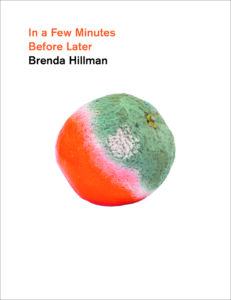
2022, Wesleyan University Press
$26. 200 pages, hardcover
(sponsored link)
Reviewed by Dave Seter
In her newest book, Brenda Hillman continues to push the boundaries of poetry, employing photographs, marginalia, and text corruption. These effects aren’t gimmicks. They represent Hillman’s efforts to find a lexicon with which to translate the mystery of existence, a phrase she uses in her poem “Dear emerging, pre-emerging & post-emerging poets.”
Hillman expresses an egalitarian spirit on the dedication page. She not only acknowledges Dr. Anthony Fauci and fellow poet Forrest Gander, but also “punctuation, especially commas & semicolons.” She also acknowledges “the irrational growth of stressed oaks & laurels chased by Apollo,” and “the number 9 mechanical pencil” stocked at her favorite stationery shop. Hillman’s reference to Apollo and the misogynistic aspects of Greek mythology continue Hillman’s tradition of intertextual reference to other works of literature.
This book has something for the environmental activist. In “Report on Another Encounter in Nature,” Hillman and her students, wearing Russian gas masks, read nature poetry in front of a supermarket, “because of what is happening to EPA.” The word EPA is followed by corrupted text which appears to read “EPA is being ruined.” The owner of the supermarket shoos away Hillman and her students. In the poem, however, Hillman gets in the last word: “I looked at his Volvo, its gas tank full of screaming dead animals from the Cretaceous.”
Of interest to the literary nerd, in “The Scattering of the Lyric I,” Hillman playfully examines what happens when the author withdraws into the background. Groupings of the lower-case letter i cluster like ragged flocks of starlings in the page’s right margin, while other beings take over center stage, including: “the tail / of a lizard put back / in the sun, // hiding in shadow, venetian assassin, // whose muse is absence, / whose dream is a weapon—”
In “Dear emerging, pre-emerging & post-emerging poets,” Hillman shows motherly concern, encouraging students sharing their unique voices with a sometimes-unhearing world: “You do not need to dumb down your art… It is not a poet’s job to simplify the mystery of existence or it’s lexicon.” Later, ever helpful, often humorous, Hillman adds: “Never look at your phone while walking downstairs.”
Finally, there’s something here for the lover. In “Escape & Energy,” a love poem to her husband, poet Robert Hass, set to a backdrop of wildfires consuming California, Hillman writes:
I pack the car while fire workers try to decide
which among them, whose worlds to save.
it’s the end of empire, i wish it were the end of empire
My love is a good sleeper;
his mind rests in its great gifts,
& we will hold hands at dawn—
Here Hillman mourns the human empire and its history of dominion over nature. Her initial confidence, that wildfires will open our eyes and bring an end to empire, pivots to wishful thinking. By ending the poem with human touch, Hillman uses a physical form of lexicon, one that connects us to all sentient beings with whom we share this planet.
Published in Cider Press Review, Volume 24, Issue 6.
 Dave Seter is an ecopoet and the author of Don’t Sing to Me of Electric Fences, Cherry Grove Collections (2021). His poems and critical works have appeared in Appalachia, Cider Press Review, Confluence, The Hopper, Paterson Literary Review, Raven Chronicles, and other journals. He has received two Pushcart nominations. He earned his undergraduate degree in civil engineering from Princeton University and his graduate degree in humanities from Dominican University of California. www.daveseter.com.
 Brenda Hillman is the author of 11 collections from Wesleyan University Press, most recently In a Few Minutes Before Later (2022), Extra Hidden Life, among the Days (2018), Seasonal Works with Letters on Fire (2013), and Practical Water (2011). With her mother, Hillman recently co-translated At Your Feet, the poems of Ana Cristina Cesar (Free Verse Editions, 2018). She presently serves as a Chancellor at the Academy of American Poets. Named by Poets and Writers as one of fifty inspiring writers in the world, she lives in the Bay Area and is Olivia Filippi Professor of Poetry at St. Mary’s College in Moraga, California.
See all items about Dave Seter
Visit Dave Seter’s contributors page.
See all items about Brenda Hillman
Visit Brenda Hillman’s contributors page.