Corrie Williamson
ISBN: 979-8988137863
River River Books (January 2025)
112 Pages, $20, Paperback
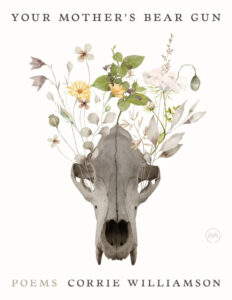
In Your Mother’s Bear Gun (River River Books, 2025), animal, vegetable, and mineral form much of each poem’s vocabulary. Like Wendell Berry and Mary Oliver, Corrie Williamson observes her world with humility and seriousness, and she makes nature a springboard for sharing a diversity of wisdom. Williamson was born on a small farm and spent time living off the grid in remote southwest Oregon, so her poetry comes from direct experiences with wild places. But it is not all reverence and awe. Your Mother’s Bear Gun explores uneasy interfaces between humans and nature, places where the natural world is by turns threatening and nourishing. This gives rise to many wonderful contrasts: sweetness and pain, death and birth, destruction and bounty. In Williamson’s hands, these contrasts create an experience for readers that is something like longing and aversion all at once. The cover art renders this perfectly—it shows a bear’s skull with flowers rising from the eye sockets.
In “Kissing the Good Green Earth,” a donkey is put down by a veterinarian. The donkey is beloved, as shown by the owner reading to him while the vet is on the way, and feeding “something / sweet, then, a squat crystal cube, an apple” (25). Saying goodbye to an animal is relatable, but the poem wouldn’t ring as true as it does if it simply ended with the donkey eating his last apple. Instead, we get this final detail: “you bent / your fingers backward, tight together, to avoid the teeth.” It’s not all sweetness—this is an animal who bites as part of its nature. And as much as there is to admire and enjoy in nature, its dangerous elements are never far away.
On the other hand, destruction begets new life in “To My Sister, on the Matter of Trees.” Here, a grove of black walnut trees is unfruitful until the largest tree at the top of the hill is felled, after which “the rest rained down, / in abundance” (28). It seems painful, possibly wasteful, to cut down the largest tree in a grove for no apparent reason (at least none that is given). But then: an unexpected bounty. Similarly, in “All in the End is Harvest,” a herd of goats belonging to the speaker’s father gives birth in late winter. One nanny and her kid don’t make it, and the carcasses are left as food for a bear. The operation of a food chain is an ordinary thing, but Williamson makes it poignant in her description of the kid’s “little spliced moon slivers of hooves,” and the bear’s odd beauty, with “maggots like stars in the night of his furred / throat” (59). The last lines are profound: “if you cannot save nor cultivate / a thing, then give it back – give it back / to the spin, the hunger, that good unending gyre.”
The contrast between life and death pulses through the poems that mention guns. Williamson’s mother’s bear gun lives in her truck so that she can feel safe on “a trillium-strewn hike by the river” (“Gun Ghazal,” 65). The repetition of the word gun, due to the poem’s form, creates a sense of menace even though the words of the poem are casually dismissive of any danger. Williamson grew up cradling guns close, as in these lines from “Keep Your Powder Dry, Little Sister” (45).
we grew up with guns. If no big sib
would protect us, we had them,
at least, against rogue dogs that
bloodied goats, opossum and fox
that snatched chickens by the throat,
flame-capped woodpeckers wrecking
the siding, and all the fear we’d been
given. Like all brothers, they reared us
for war.
And yet, when in “Mercy Me” (95), her father suggests that she take a pistol with her into the wilderness, she refuses.
That was not
how I imagined my days, strapping its cold weight
to my hip, a saunter to the river: Good morning
larkspur, good morning death camas and moon-
flower: I am more deadly than you.
In those lines, I find the poet’s answer to the question implied in the contrasts mentioned above. That question being, how does one live and behave with respect to other people, plants, and animals in a world that is by no means safe? The answer is to live with “unarmed hands” (97). There is of course real risk in this, but the alternative creates other, arguably worse, kinds of trouble. Williamson’s writing has uncommon integrity in the way it comprehends both nature’s loveliness and its perils. In her writing, beauty doesn’t mitigate danger, though danger can put beauty into sharper relief.
Published in Cider Press Review, Volume 28, Issue 1.
 Emily Updegraff is a staff member and an MFA student at Northwestern University. She has published poems in journals including Third Wednesday, The Orchards Poetry Journal, and Umbrella Factory, and is a regular book review contributor at Great Lakes Review.
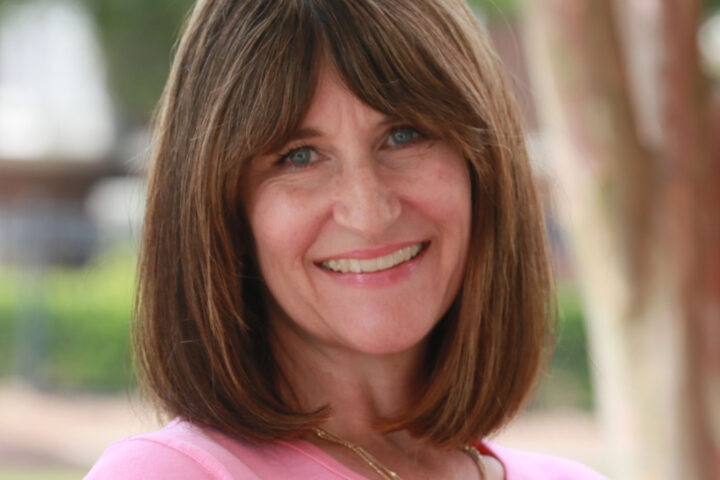
 Corrie Williamson was born on a small farm in southwestern Virginia. She is the author of two previous books of poetry: The River Where You Forgot My Name, which was a 2019 Montana Book Award Honor Book, and Sweet Husk, which won the 2014 Perugia Press Prize and was a finalist for the 2015 Library of Virginia Poetry Award. She lives in Montana.
See all items about Emily Updegraff
Visit Emily Updegraff’s contributors page.
See all items about Corrie Williamson
Visit Corrie Williamson’s contributors page.