

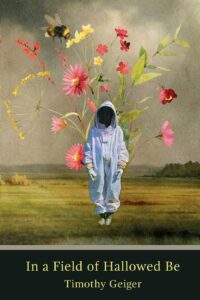
Timothy Geiger
ISBN: 978-1947896772
Terrapin Books
124 pages, $18, Paper
Reviewed by Merryn Rutledge
In Timothy Geiger’s In a Field of Hallowed Be (Terrapin Books, 2024), his fourth full-length book, Geiger celebrates a farmer’s concerns with planting and harvesting, tending animals, and attending to weather. Geiger explores greening and dying, wonder, and “the violence of this world” (90). He reflects on relationships with beloved and ornery people.
Geiger announces a major theme in the opening lines of his first poem, “After All”:
I carry my impermanence in layers of bone,
muscle, skin…
out here, to this permanence
that even now may be fading (3).
Here we glimpse the way Geiger plays with contrasts. His mortality contrasts with the land’s permanence, which, at least on the surface, will fade when the farmer turns the field into an orchard. In “Back Country,” the speaker, remembering a friend who died in a car accident, acknowledges the constancy of change: “Whatever comes/ between now and the next blind turn… the creek below keeps rushing by,” as do our lives. Not surprising for a farmer, Geiger frequently associates impermanence with death, as in “Hex,” where a dead rabbit’s “entrails…form a question./ Rain?/ Rebirth? All things ending?” The speaker queries possibility: from imminent rain to the world’s end; from death to some rebirth.
Some poems’ lineation highlights contrasting ideas. In “Stump,” for instance, lines can be read four ways: left to right and as three columns.
This body
trying
to collect
so much
past tense.
What’s lost
is lost
and trying
to get
it back
makes time
stop… (52)
The assertion that losses are permanent is compared with the way our memories preserve time. Columns of words reinforce contrasts. “To collect/ What’s lost/ to get/ stop” highlights collecting/ getting juxtaposed with losing/ stopping. “This body/ so much/ is lost/ it back” contrasts losing and getting back. In her book of essays Ten Windows, Jane Hirshfield might be speaking of this poem when she writes, “If this seems strange and hard to follow, that’s exactly the point. Paradox is the coiled secret, the place in a poem…[that] releases a big hidden drawer inside which much of the real work is done…when the impossible enters the mind, the carrying capacity of thought increases.” Contrasts, paradoxes, oxymorons, and contradictions between poems expand us.
The tone of many of Geiger’s poems is elegiac. Words like “sadness”, “somber,” “sorrow,” “sorry remains,” and “weeping” appear throughout the book, as does somber description. “Sunrise and I’m cold/ of heart, bruised/ as the apple dropped” the narrator says in “Retreat,” (45) evoking humankind’s mythical fall. In “Invisible Birds,” their “calls descend and surround the chill stillness/ that drapes the air” (41), as the speaker, far from his beloved son, feels a chill in his heart.
Geiger also finds wonder in his surroundings. “Guardian of the Farm” begins “In this moment, in the violence of all this world we inhabit.” A muskrat’s sudden appearance transforms the speaker’s view: “all judgment is temporarily repaired/ by wonder” (90). “Field Guide,” a long poem on several species of wildflowers, begins with goldenrod.
For two weeks every year I’m alive
They rise and burn the meadow
Amber shock and cacophony
Ceding to wonder (91).
The stanza also exemplifies Geiger’s attention to craft. Notice the iambs, varied in “ceding,” with the long “ee”— the vowel also rhyming with the end of “cacophony.” Listen to Geiger’s music here:
Swarming the silver maple’s branches
in a loose murmuration of gold pocked rust,
a constellation of starlings chatters
their explanations of divinity
to the wind (60).
These lines also reveal the way Geiger transforms description into transcendent image. Beside his father’s deathbed in “Father at the End,” Geiger gives us machines that “hum like gnostic saints,” his own night watch, “a glowing vigil/ around his sleeping form” (71). Both speaker and dying man are beatified. Elsewhere the narrator pictures the prairie, with “timothy grass/ as a sort of transcendence./ And by grass, I mean gold fires…” (77). Grass becomes a golden realm, on fire in the sunshine.
The book’s final poems revisit themes. “The Center” contrasts perspectives: the farmer’s movements and winter’s frozen stillness; the farmer’s cold body with his wife’s warm presence in the farmhouse; “the past a reel/ unwound” and “still spinning.” “Will the center/ remain the same?” (102) the narrator asks, shifting Yeats’ “the center will not hold.” Yet the narrator anticipates making plans with his wife to enlarge the field and, more generally, plan their future—“tomorrow and the next after that. I can’t wait/ to make them with you” (102). All the while, “The field remains unresolved before me” (102). It will keep changing and manifesting. The field here is farm land and a farmer’s field of vision—the physical bounded by tilled soil and what the eye sees, the poet’s field of imagination boundless.
References:
Hirshfield, Jane. (2017). Ten Windows, How Great Poems Transform the World. New York: Alfred A. Knopf, p. 276.
Whitman, Walt. Song of Myself, 51. Academy of American Poets. Retrieved December 20, 2024 from https://poets.org/poem/song-myself-51
Yeats, W. B. “The Second Coming.” The Poetry Foundation. Retrieved December 20, 2024 from https://www.poetryfoundation.org/poems/43290/the-second-coming
Published in Cider Press Review, Volume 27, Issue 2.
 Timothy Geiger is the author of three previous full-length poetry collections: Weatherbox, winner of the 2019 Vern Rutsala Poetry Prize from Cloudbank Books; The Curse of Pheromones (Main Street Rag); and Blue Light Factory (Spoon River Poetry Press). He is also the author of ten chapbooks, most recently Holler (APoGee Press). His poems have been included in the anthologies American Poetry: Next Generation (Carnegie Mellon University Press), Place of Passage (Storyline Press), and A Fine Excess: Contemporary Writers at Play (Sarabande Books). His honors include a Pushcart Prize XVII; a Holt, Rinehart and Winston Award in Literature; and many state and local grants from Alabama, Minnesota, and Ohio. He is the proprietor of Aureole Press, a letter-press imprint producing chapbooks of contemporary poetry at the University of Toledo, where he teaches creative writing, poetry, and book arts. He lives on a small farm in Swanton, Ohio, with his wife and all their animals.
 Merryn Rutledge’s poems have appeared widely throughout the world in journals and anthologies. Her collection Sweet Juice and Ruby-Bitter Seed is available from Kelsay Books. Merryn enjoys teaching poetry craft, reviewing poetry books by women (Tupelo Quarterly, Pedestal, and elsewhere), singing, dancing, and working for social justice causes. Merryn holds two degrees in literature. Writing poems is a third vocation, after teaching literature, film studies, and creative writing at Phillips Exeter Academy, and then, with a doctorate in leadership, running a leadership development consulting firm. During that career phase, Merryn’s field research on leadership was published as books, chapters, and in peer reviewed journals. Merryn lives near Boston, MA.
See all items about Timothy Geiger
Visit Timothy Geiger’s contributors page.
See all items about Merryn Rutledge
Visit Merryn Rutledge’s contributors page.